admin
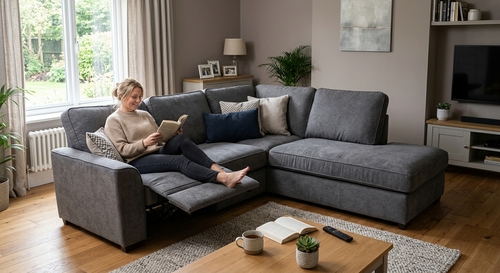
A corner recliner sofa combines two things people want from living room seating: space for the whole household and a way to put their feet up. The L-shaped layout runs along two walls and turns an unused corner into seating, while the reclining seats let each person set their own position.
The combination brings its own planning questions, though. A reclining corner needs more space than a fixed one, more power points and more thought about which seats actually move. This guide covers what to check before you order.
Why combine a corner layout with reclining seats
A fixed corner sofa already seats more people than a straight sofa in the same room. Adding reclining mechanisms means those people can stretch out individually, without one person’s footrest disturbing anyone else. On powered models, each seat has its own control, so one person can lie back while the rest of the sofa stays upright.
That makes the format popular for family rooms, media rooms and larger home cinemas, where a group wants to watch together but each person has a different idea of comfortable.
Measuring for clearance on both runs
The most common mistake is measuring a reclining corner like a fixed one. With the seats reclined, the footrests extend beyond the normal footprint of the sofa, and on many mechanisms the backs travel too.
Before choosing a corner recliner sofa, measure both walls it will use and then add the movement. Allow roughly 50 cm in front of every reclining seat and around 40 to 50 cm behind for the back to travel, unless the design is a wall hugger, which slides forward as it reclines and needs as little as 10 cm behind it.
Measure the room with the seats fully extended, not upright, and check that no reclined footrest will block a doorway or a walkway.
Which seats actually recline?
Not every seat on a corner recliner moves. On a sofa with a chaise, the chaise usually gives full-length support without a mechanism, while the seats on the opposite run recline. On some three-seat runs, the centre seat stays fixed and folds down into a console with cup holders.
Neither is a fault, but both change how many people can recline at once. Confirm which sections move on the specific model before you decide how many seats you need.
Power, sockets and cable runs
A powered corner recliner needs one supply per reclining seat. On a large configuration, that is worth planning before delivery: decide where the transformers will sit so that cables do not cross a walkway or have to be stretched to the nearest socket.
Where a socket behind the sofa is not practical, battery packs are available on many models. If the layout of the room is fixed, mention it when you specify the sofa so the right mechanism can be chosen.
Fabric or leather on a reclining corner
Leather holds its shape well around a moving frame and wipes clean quickly, which suits a sofa used every evening. It will show soft creasing at the hinge points over time, which is normal wear on a seat that moves.
Fabric gives a softer, warmer feel and a wider range of colours and textures. In a busy family room, choose a fabric with a practical weave, and order samples to see the colour in your own light.
Corner recliners for smaller rooms
A reclining corner does not have to be enormous. Small corner recliner sofas keep the reclining L-shape within a compact footprint, which makes them workable in snugs and smaller living rooms where a full-size reclining corner would not fit.
For a narrow cinema room, however, a straight row of seats often fits the sightlines better than a corner. The corner format comes into its own where the room is wide enough for both runs to face the screen or the television comfortably.
Measure with the seats reclined, confirm which sections move, plan the sockets and choose upholstery for how the room is really used. Done in that order, a reclining corner becomes the most comfortable seat in the house rather than the most awkward piece of furniture to live with.